
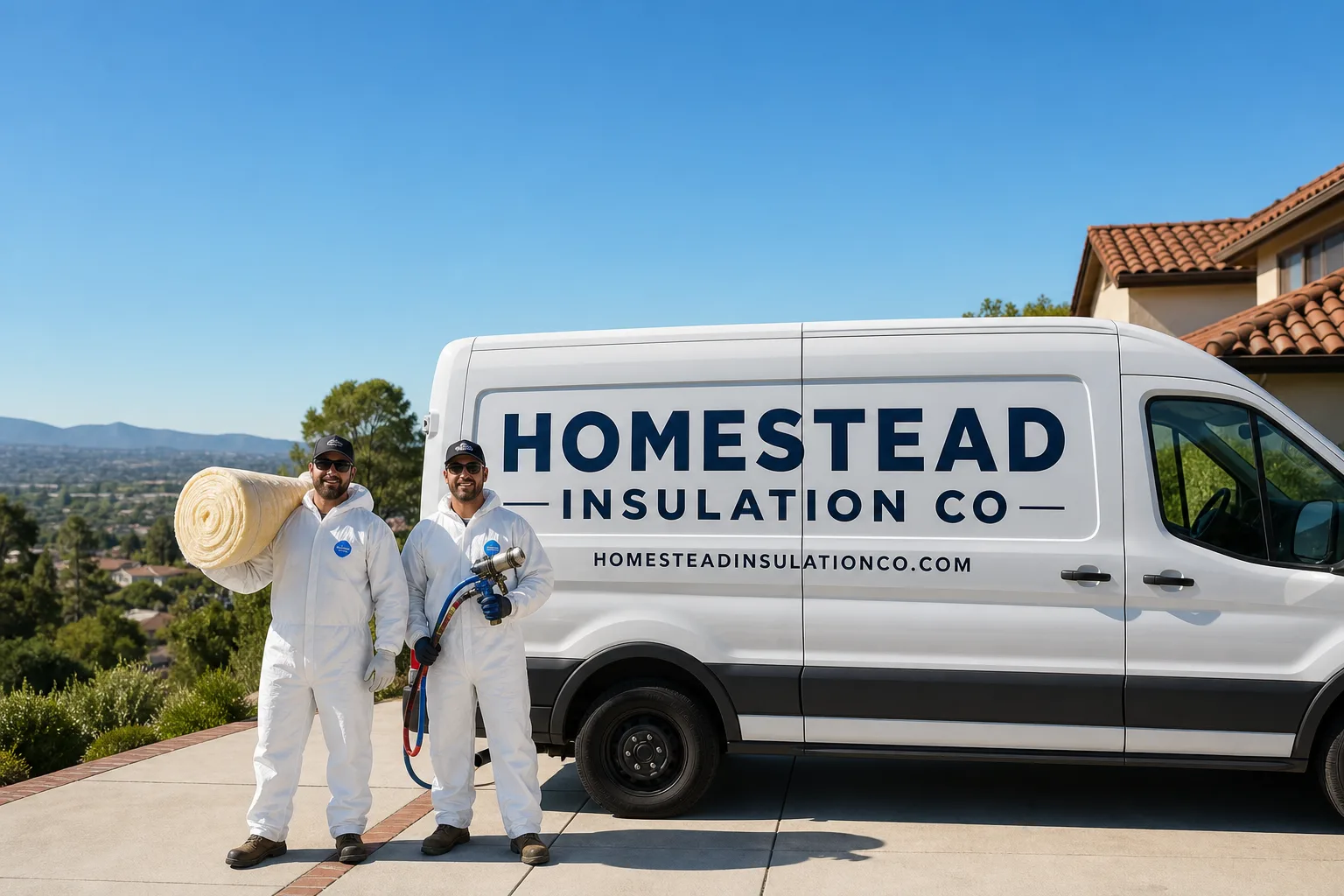
Fast, Reliable Spray Foam Insulation Across South Whittier
Spray foam insulation in South Whittier is a full retrofit job on most houses, not a simple top-off. The 1950s and 60s stucco tract homes that dominate the 90605 zip code were built with empty wall cavities and attics that have slowly lost whatever fiberglass was originally installed. When you call Homestead Insulation Co, you’re getting a crew that knows exactly what’s behind those stucco walls and above those textured ceilings. We work across South Whittier weekly, and we can usually have a technician at your door within 48 hours. Call (844) 820-1136 and we’ll talk through what your house actually needs.
Why Homestead Insulation Co Is South Whittier’s Preferred Spray Foam Insulation Company
We’re not a general contractor who happens to own a spray foam rig. Insulation is all we do, which means the crew that shows up at your South Whittier home has spent their entire career thinking about air sealing, thermal barriers, and how old California tract houses move air. Alan Brecker built Homestead Insulation Co around a simple idea: prescribe the right material for the house, not the material that’s easiest to install. That matters in South Whittier because the housing stock here is specific, and the fix is rarely one-size-fits-all.
South Whittier homeowners call us because they’ve noticed rooms that never cool down in August, attics that smell musty, or utility bills that climb every summer. We know the blocks off Telegraph Road, the streets east of the 605, and the older parcels where homes still have their original single-pane windows. That local familiarity means we arrive already knowing what we’re likely to find. It also means we don’t waste your time re-learning your neighborhood.
Response time to South Whittier is a priority for us. A call on Monday usually gets a technician on site by Wednesday. Emergency calls for sudden air leaks or water-damaged foam get scheduled faster when we have a crew in the area. Call (844) 820-1136 and we’ll get you on the calendar.
Spray Foam Insulation Contractors in South Whittier
Spray foam insulation contractors in South Whittier have to understand what happens inside a 1950s stucco wall cavity that has never held insulation. These walls are typically framed with 2×4 studs, sheathed, and then covered in cement plaster that forms the exterior skin. The cavity between the interior drywall and the exterior sheathing has been empty for sixty-plus years. When we foam those cavities, we’re creating the first real thermal boundary the house has ever had. Most full wall cavity retrofits in South Whittier run $3.50 to $6.00 per square foot of wall area, depending on foam type and access. Attic jobs run $2.25 to $4.50 per board foot at typical depths. Rim joist sealing usually lands between $1,200 and $2,800 for a single-story tract home here.
Closed-Cell Foam for Stucco Tracts
Closed-cell spray foam is the workhorse in South Whittier’s older homes. It acts as both insulation and an air barrier while adding structural rigidity to those aging stud walls. In a 1957 stucco tract house with no wall insulation, closed-cell foam in the wall cavities cuts the cooling load dramatically and seals the wall against outside air infiltration. It also helps with the air-quality issue that comes from living near the 605 and the refinery corridor, because it stops outdoor air from drafting through the walls.
Open-Cell Foam for Attic Roof Decks
Open-cell foam is the right choice for many South Whittier attic roof decks and garage ceilings. It’s more forgiving on older framing, expands to fill odd cavities, and costs less than closed-cell. For attics in the single-story homes around Telegraph Road, open-cell foam sprayed to the underside of the roof deck turns the attic into conditioned space, which means the ducts up there stop losing cooled air into a 140-degree space in August.
Spray Foam Attic Insulation in South Whittier
Spray foam attic insulation in South Whittier almost always starts with removal. A typical 1950s-60s house here had a few inches of fiberglass batts laid between the ceiling joists when it was built. By now, that fiberglass has settled, been tunneled by rodents, and often smells like decades of dust and droppings. Foaming over the top of it traps contaminated material underneath. Our techs in South Whittier regularly pull out the old batts, sanitize the attic deck, then foam the roof deck or the floor, depending on your HVAC setup. Most South Whittier attic jobs run $2,800 to $7,500 when you include full removal, air sealing, and new foam.
Removal Before Foam
When we open an attic in South Whittier and find rodent tunnels through the old fiberglass, we don’t just spray over it. Pulling the old material lets us inspect the top plates, find the holes where wires and pipes pass into the walls, and seal those penetrations before the foam goes in. The result is a continuous air barrier that actually works. Skipping removal is why some South Whittier homeowners end up with foam that didn’t cut their bills as much as promised.
Duct Sealing in Conditioned Attics
We won’t foam a South Whittier attic and ignore the ducts. Duct runs through unsealed attics leak cooled air into the hot space, and no amount of spray foam on the roof deck fixes that. We seal duct seams and connections with mastic or spray foam during the same job. When we foam the roof deck, we’re moving the thermal boundary to the roofline, and the ducts finally live inside the conditioned space. That’s how you get the payback on your utility bill, not just a nicer-looking attic.
On a block off Telegraph Road, our crew opened an attic in a 1957 single-story stucco tract house and found the original fiberglass batts settled to a few inches with clear rodent trails through it. We pulled the old material, sealed the top plates and penetrations with closed-cell spray foam, and foamed the wall cavities that had never been insulated, tying in the duct sealing at the same time to close the leaks that had been pulling attic air into the living space. That’s the whole job. That’s what this type of home needs.
Trusted Brands We Service in South Whittier
Homestead Insulation Co is authorized to install spray foam products from several industry-leading manufacturers, and we’ll match the right one to your South Whittier home. We regularly work with Demilec closed-cell and open-cell foam, and we also install green options like GreenFiber cellulose when a homeowner wants a lower-impact material for parts of the job. Because we stock multiple product lines from Owens Corning and Johns Manville as well, we’re not locked into selling one brand. We pick the foam that fits your wall assembly, your roof structure, and your budget. That independence is why South Whittier homeowners trust us to make the call. Visit our Spray Foam Insulation page to see the full range of materials we install. For South Whittier-specific service details, head to our South Whittier page.
Common Spray Foam Insulation Problems We See in South Whittier Homes
- Settled and rodent-damaged fiberglass under fresh foam. Crews that spray foam over old batts without removing them lock contaminated material into the attic. We pull everything first, inspect the deck, and then foam. If you smell something stale in your attic, it’s probably time.
- Uninsulated wall cavities in 1950s-60s stucco construction. Many South Whittier homes have zero insulation in the walls. Foaming only the attic and ignoring these cavities leaves the biggest cooling-load source untouched. We drill and fill from the exterior when possible or work from the interior when the stucco can’t be touched.
- Leaky ducts in unsealed attics. The foam gets blamed for a hot house, but the real problem is duct runs leaking conditioned air into the attic. We test, seal, and verify as part of the attic job. It’s all one system, not separate projects.
- Rodent activity in attic spaces near the 605 and Telegraph Road corridors. Older attics here get rat and mouse traffic. We look for trails, nesting, and chew damage on wires before we insulate. Sealing entry points with closed-cell foam and wire mesh is part of the prep.
Pricing for Spray Foam Insulation in South Whittier, CA
Spray foam insulation in South Whittier typically runs $2.25 to $4.50 per board foot at standard attic depths. Wall cavity retrofits in the 1950s-60s stucco homes run $3.50 to $6.00 per square foot. A full attic foam job with removal, air sealing, and duct sealing on a 1,200-square-foot single-story home in 90605 generally lands between $5,500 and $9,800. Rim joist spray foam runs $1,200 to $2,800. Garage ceiling foam runs $1,800 to $4,200 depending on the ceiling area and whether you want open or closed cell. Every quote is specific to your house. We measure, inspect, and give you the number before any work starts. Estimates are free. Call (844) 820-1136 to schedule a walkthrough.
We Also Serve Cities Near South Whittier
Our crews cover the surrounding area, including Whittier, East La Mirada, La Mirada, and Santa Fe Springs. If you’re in one of those cities and need spray foam insulation, we can usually have someone out within a few days. Call (844) 820-1136 and let us know where you are.
Serving South Whittier, CA — Our Local Coverage Area
We’re based in the South Whittier area and know this community well. Use the map below to see our service coverage — if you’re nearby, we can almost certainly help.
FAQs About Spray Foam Insulation in South Whittier
Yes. We can inject foam into the wall cavities by drilling from the exterior through the stucco or from the interior through the drywall, depending on your siding condition and interior layout. Exterior drilling leaves small plugs we patch and texture to blend. Interior drilling is patched and painted on your schedule. On these 1950s-60s South Whittier tract homes, the wall cavities are usually clean and empty, which makes injection straightforward. Call (844) 820-1136 and we’ll walk you through the access points we’d use on your specific house.
Rodents love the warm, dry attics in these older homes, and the settled fiberglass batts make perfect nesting material. They tunnel through the old insulation, shred it for nests, and leave droppings throughout. That’s why we remove the old material before foaming. If we foamed over it, we’d seal the contamination in. We seal entry points during the prep so the new foam stays clean.
If your ducts run through an attic that gets hot in summer, yes. Leaky ducts pull attic air into your living space and push cooled air into the heat. We seal the ducts with mastic or foam during the attic insulation job. It’s not an add-on; it’s part of the same air-sealing work. Call (844) 820-1136 and we’ll check your duct runs during the estimate.
Spray foam alone cuts AC costs significantly when applied to the roof deck or the attic floor at the right depth. A radiant barrier helps in attics where the roof deck is not foamed, because it reflects heat before it radiates into the attic space. But when the roof deck is foamed with closed-cell or open-cell at the recommended depth, the radiant barrier is usually unnecessary. For most South Whittier homes, foaming the attic plus sealing the walls and ducts gets the biggest bill reduction.
It can, if you seal the house without addressing ventilation and moisture. Tight houses need controlled airflow. We typically recommend a mechanical ventilation strategy, especially in South Whittier homes near the refinery corridor and 605 where outdoor air quality is a concern. Properly sealed walls and attic actually improve indoor air quality by shutting out uncontrolled drafts. We’ll talk through the ventilation plan during the estimate. Call (844) 820-1136 with any questions.
If your South Whittier home still has its original 1950s insulation or no wall insulation at all, the fix is not a quick top-off. It’s a full retrofit: removal, sealing, wall cavity fill, and duct work done together. That’s what we do. Call Homestead Insulation Co at (844) 820-1136 for a free estimate, and we’ll tell you exactly what your house needs.
Written by Alan Brecker, Owner at Homestead Insulation Co, serving South Whittier and surrounding Los Angeles County communities.