
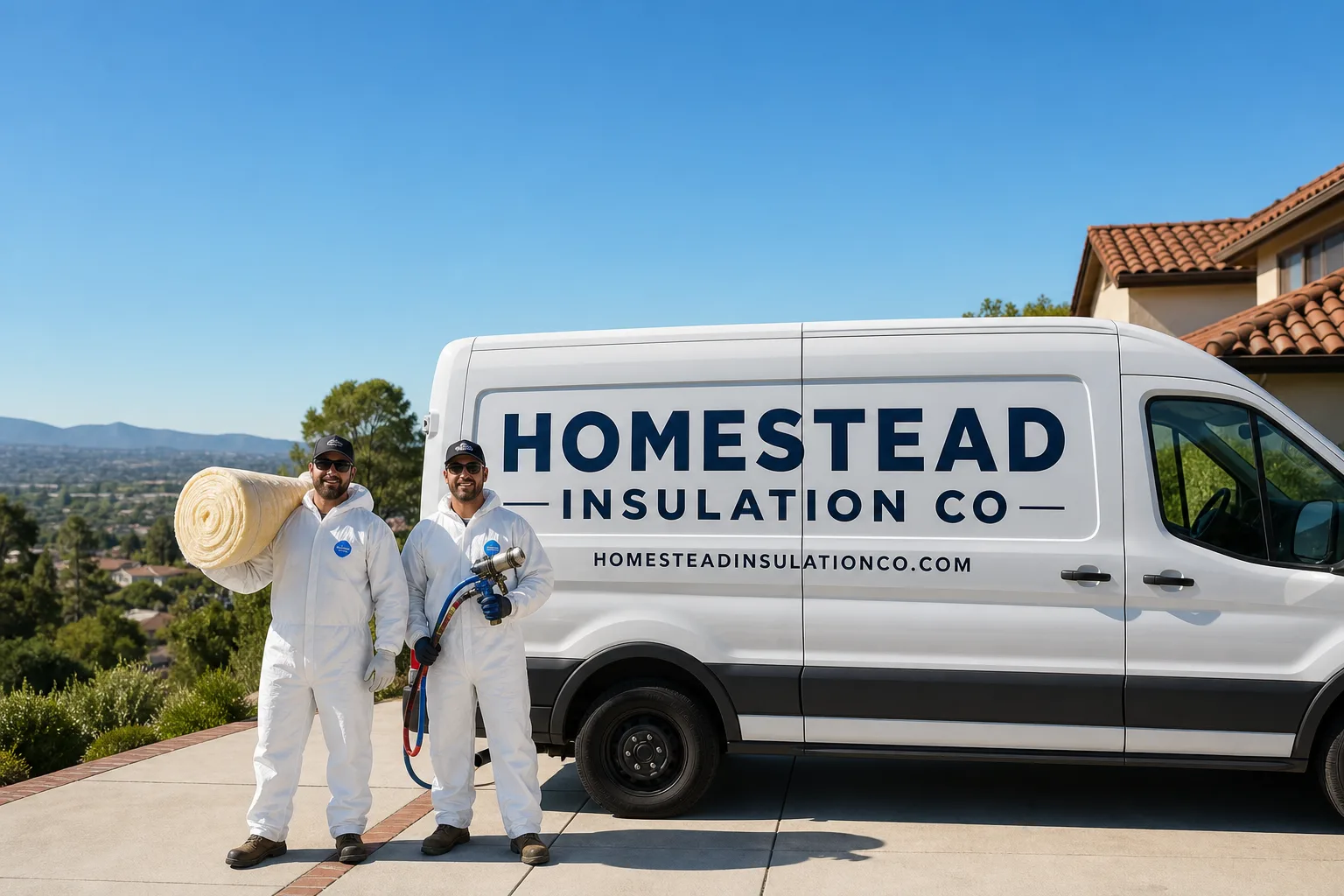
Fast, Reliable Spray Foam Insulation Across Santa Ana
Spray foam insulation in Santa Ana typically costs $2.50 to $6.00 per board foot for open-cell and $4.50 to $9.00 per board foot for closed-cell, with most attic projects landing between $3,800 and $9,500 depending on square footage and whether old insulation needs removal first. We run crews into Santa Ana every weekday, and we can usually start within 3 to 5 business days of your estimate. If you’re dealing with a drafty 1940s bungalow off Main Street or a sweltering post-war tract home near the Santa Ana River corridor, call (844) 820-1136 and we’ll give you an honest assessment of what your house actually needs.
We’re not a general contractor squeezing insulation between roofing jobs. Insulation is all we do, and we’ve spent years learning how Santa Ana’s specific housing stock responds to spray foam. That matters more here than in most Orange County cities, because Santa Ana’s homes weren’t built for this climate. They were built before air conditioning was standard, before wall insulation was code, and long before anyone thought about air sealing. A one-size recommendation won’t cut it. That’s why our Spray Foam Insulation team starts every job with a diagnosis, not a product pitch.
Why Homestead Insulation Co Is Santa Ana’s Preferred Spray Foam Insulation Company
Santa Ana homeowners call us because we answer the phone, show up when we say we will, and don’t push a material we happen to have loaded on the truck. We install spray foam from Icynene and Demilec, but we also work with Owens Corning, Johns Manville, Knauf, and GreenFiber when a job calls for something different. That breadth means our recommendation is driven by what your house needs, not by what we’re incentivized to sell. Alan Brecker built the company around that principle. It shows in how we quote, how we prep, and how we clean up.
Our crews know the 92701, 92702, 92703, 92704, and 92707 zip codes well. We’ve worked in French Park, Lacy, Floral Park, and the neighborhoods surrounding Santa Ana College. When a homeowner on a tree-lined street in Floral Park asks whether closed-cell foam will compromise their original plaster crown molding, we can answer from experience, not theory. When a rental property owner near the civic center asks what’ll hold up to tenant turnover, we tell them straight. That local depth is hard to fake, and it’s why homeowners keep referring us to neighbors.
Our standard response time to Santa Ana is same-week, with emergency calls for major air leaks or rodent-damaged insulation often handled within 48 hours. We are licensed and insured, and every job gets a written scope before we start. Estimates are free. Call (844) 820-1136 to schedule yours.
Crawl Space Spray Foam Insulation in Santa Ana
Crawl Space Spray Foam Insulation in Santa Ana is a retrofit job we recommend for the raised-foundation homes concentrated in the older 1920s-1950s tracts off Bristol Street and Broadway. Most of these houses have vented crawl spaces with fiberglass batts sagging between floor joists or no insulation at all. In a semi-arid climate like ours, the crawl space doesn’t usually fight standing water the way it does back east, but it does fight heat gain from the ground and dust that blows in through foundation vents during Santa Ana wind events. We typically spray closed-cell foam directly onto the subfloor from below, sealing the rim joists and creating a continuous thermal break. A typical Santa Ana crawl space encapsulation with spray foam runs $3,200 to $6,800 depending on square footage and access.
Rim Joist Sealing
The rim joist is the band of wood where the floor framing meets the foundation wall, and it’s the single leakiest part of most Santa Ana crawl spaces. We spray closed-cell foam along the entire rim, which stops air infiltration and blocks the fine dust that Santa Ana winds push through foundation vents every fall. This is usually a one-day job, and it pays for itself in lower summer cooling bills because your floor stops radiating heat up into the house.
Open-Cell vs. Closed-Cell Below the Floor
Open-cell foam below the subfloor is less common here. We usually spec closed-cell for crawl spaces because it adds structural rigidity to older joists, resists moisture wicking, and won’t absorb the dust and rodent odors that plague Santa Ana’s raised foundations. The cost differential is real, roughly 35-45% more than open-cell, but for a 1930s stucco bungalow with original hardwood floors above, it’s the technically correct call.
Garage Spray Foam Insulation in Santa Ana
Garage Spray Foam Insulation in Santa Ana is a job we do constantly because so many homes here have attached garages that face west or southwest, turning them into ovens by 2 p.m. in July. Whether you’re using the garage as a workshop, a home gym, a laundry space, or just parking cars, an uninsulated garage ceiling and walls add heat load to the rest of the house. We usually spray closed-cell foam on the garage ceiling and the shared wall between garage and living space, plus the rim joists if accessible. A typical two-car garage in Santa Ana runs $2,800 to $5,400 for ceiling and shared wall coverage.
Garage Ceiling Spray Foam
This is the highest-impact insulation job for a Santa Ana attached garage. We spray the underside of the roof deck or the garage ceiling joists, depending on whether the attic space above is vented. The goal is keeping the garage under 85 degrees in August, which means your adjacent kitchen and family room don’t fight that extra heat all afternoon. Most garage ceilings in Santa Ana’s 1960s-1970s tract homes are R-19 fiberglass at best, often compressed and failing. Closed-cell foam at 3 inches gives you roughly R-21 plus a real air seal.
Shared Wall Insulation
The wall between garage and house is almost always under-insulated, and it’s usually the easiest wall in the house to spray. We get into the wall cavity from the garage side, which means no drywall removal inside your living space. That keeps the job fast and low-dust. When the shared wall is sprayed and the garage door weather-sealed, homeowners consistently report their living room stays comfortable later into the evening without cranking the AC.
Trusted Brands We Service in Santa Ana
We install spray foam from Icynene and Demilec, and we carry the full line of Owens Corning, Johns Manville, Knauf, and GreenFiber products for jobs that call for batts or blown-in instead. That matters in Santa Ana because the right answer for a 1940s Floral Park bungalow might be closed-cell at the roof deck, while the right answer for a 1970s track home near Saddleback High might be open-cell in the attic plus new blown-in over the top. We stock local inventory and stage materials based on the specific job, which means fewer delays and no surprise mid-project substitutions. “Eight trusted manufacturers, one specialist team” isn’t a slogan. It’s how we buy, stock, and quote.
Common Spray Foam Insulation Problems We See in Santa Ana Homes
- Dust-fouled foam at the roof deck edge. Fall Santa Ana winds push fine dust and palm frass through gable and soffit vents, and that dust sticks to freshly sprayed open-cell foam. Within a season or two, the foam looks dirty and loses some of its air-seal performance at the perimeter. We seal vent paths before spraying to keep this from happening.
- Rodent-nested loose-fill under new foam. The 92703 bungalows and properties near the Santa Ana River corridor have real rodent pressure. We’ve opened attics where old loose-fill was tunneled through with rat runs and matted with droppings. Spraying over that traps the contamination and the odor. We remove and bag it first, every time.
- Plaster walls that still radiate heat. Homes built in the 1920s through 1950s have wood-frame walls with no cavity insulation and original plaster over lath. Spraying the attic and leaving those walls uninsulated means the plaster envelope keeps pumping heat into rooms all afternoon. It’s a partial fix, and we’ll tell you that before we quote.
- Flat and low-slope roof complications. Santa Ana has a surprising number of flat-roof and low-slope structures, especially on older commercial conversions and mid-century modern homes. Spraying the underside of a low-slope roof deck changes the thermal profile, and getting the ventilation math wrong causes condensation at the deck line. We inspect the roof assembly before recommending foam there.
Pricing for Spray Foam Insulation in Santa Ana, CA
Open-cell spray foam in Santa Ana runs $2.50 to $6.00 per board foot installed. Closed-cell runs $4.50 to $9.00 per board foot. That translates to about $3,800 to $7,200 for a typical 1,200-square-foot attic at 3 inches of open-cell, or $6,500 to $9,500 for the same attic with 2 inches of closed-cell. Rim joist sealing in a raised-foundation home usually lands between $1,400 and $2,800. Crawl space encapsulation runs $3,200 to $6,800. Garage ceiling and shared wall jobs run $2,800 to $5,400. The biggest cost driver in Santa Ana is whether old insulation needs removal before we spray. Rodent-damaged or dust-contaminated loose-fill in a 1940s attic can add $1,500 to $3,000 to the job. We quote that work explicitly and don’t bury it in the per-board-foot price. Call (844) 820-1136 for a free written estimate.
We Also Serve Cities Near Santa Ana
Our crews cover Santa Ana and the surrounding communities every week. You’ll find us in Tustin, North Tustin, Fountain Valley, and Orange on a regular basis, often starting a job in one city and finishing across the street in another. If you’re in one of those areas and your home has the same mid-century stucco-and-plaster envelope we see in Santa Ana, the recommendation will likely be similar. Call (844) 820-1136 and we’ll tell you straight.
Serving Santa Ana, CA — Our Local Coverage Area
We’re based in the Santa Ana area and know this community well. Use the map below to see our service coverage — if you’re nearby, we can almost certainly help.
FAQs About Spray Foam Insulation in Santa Ana
Yes, spray foam can be installed in a 1920s bungalow without touching the original plaster walls, as long as we’re working from the attic side or the exterior wall cavity. We don’t cut into plaster unless you specifically want wall injection done, which requires a different conversation. The priority on an older stucco-and-plaster home is usually the attic and rim joists first, since that’s where the heat gain and air leakage concentrate. Sealing the roof deck with closed-cell foam and the rim joists with closed-cell spray gives you most of the comfort gain without any intrusion into finished rooms. Call (844) 820-1136 and we’ll walk the house with you before recommending anything.
Yes, the Santa Ana wind events each fall push fine dust and palm frass through attic vents and into loose-fill insulation, forcing re-blowing or removal far sooner than the R-value alone would suggest here. We see this pattern most in north Santa Ana and near the Santa Ana River corridor, where the wind gets funneled harder and the palm density is high. The fix is sealing the vent paths with closed-cell foam at the roof deck and making sure soffit vents aren’t ingesting dust. It’s a Santa Ana-specific problem that inland cities don’t see to anywhere near this degree.
In Santa Ana, open-cell foam is the more common attic recommendation because our cooling load is bigger than our heating load, and open-cell handles heat gain at the roof deck well when installed at 5-6 inches. Closed-cell is the better call when the attic is unvented, when the roof deck is low-slope, or when rodent exclusion and moisture resistance matter more than raw R-value per dollar. For most 1950s-1970s tract homes, open-cell plus proper ventilation gives the best cost-to-performance ratio. On a 1940s bungalow with wind-driven dust, we lean toward closed-cell at the deck edge to keep dust out and adhesion strong.
Yes, in Santa Ana most attached garages benefit from spray foam on the ceiling and the shared wall, especially west-facing garages that soak up afternoon sun. An uninsulated garage adds heat to the whole house in summer and makes the garage unusable as a workspace from June through September. A typical two-car garage in Santa Ana runs $2,800 to $5,400 for ceiling and shared wall coverage. It’s one of the fastest payback jobs we do because the comfort change is immediate.
No, we don’t spray over rodent-damaged or heavily dust-contaminated loose-fill. The old material has to be vacuumed out, the attic sanitized, and the vent paths sealed before any foam goes down. In the 92703 bungalows and near the river corridor, we remove contaminated fill on a near-weekly basis. It adds $1,500 to $3,000 to a typical attic job, but spraying over it would trap odor, waste adhesion, and bake the problem into the house for decades. We’ll show you photos of what we pull out before we quote the removal.
Ready to talk about your Santa Ana home? Call us at (844) 820-1136 for a free, no-pressure estimate. We’ll inspect your attic or crawl space, explain exactly what we found, and give you a written scope with real numbers. Insulation is all we do, which means it’s done right.
Written by Alan Brecker, Owner at Homestead Insulation Co, serving Santa Ana and Orange County with material-agnostic insulation expertise.