
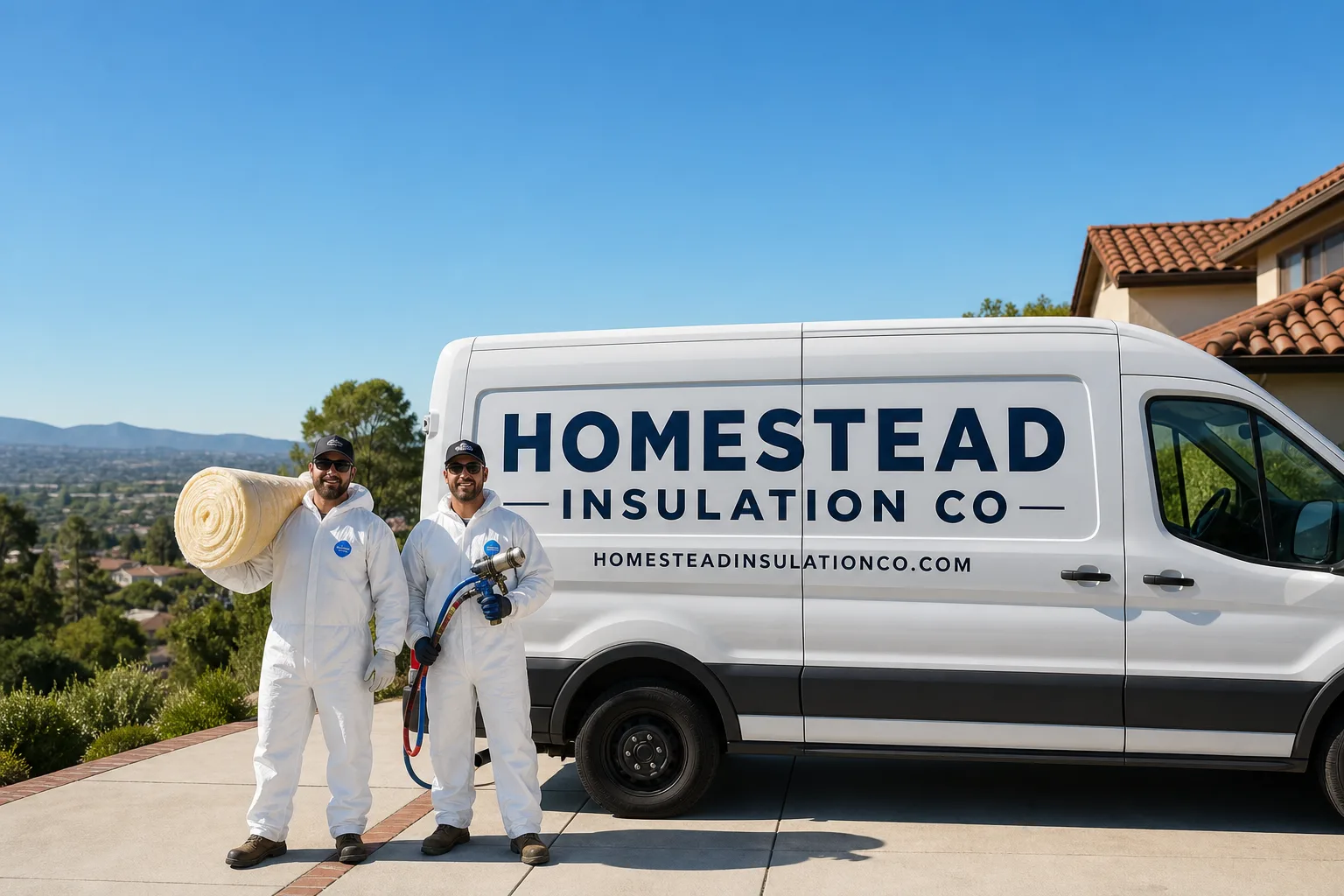
Fast, Reliable Spray Foam Insulation Across Corona
Spray foam insulation in Corona costs between $2,200 and $6,800 for a typical attic or rim joist job, with open-cell foam running $0.45 to $0.75 per board foot and closed-cell running $1.10 to $1.75. Most Corona homes we work on need air-sealing and spot-foaming rather than full cavity fills, especially in the older west-side tracts. We get to most Corona neighborhoods within 45 minutes from our Orange County base, and Alan Brecker’s team knows exactly what your house needs before we even back the truck up. Call (844) 820-1136 for a straight answer on what foam work your Corona home actually needs.
Why Homestead Insulation Co Is Corona’s Preferred Spray Foam Insulation Company
We’re not a general contractor who picked up a foam rig last year. Insulation is all we do, and that means every crew member who shows up at your Corona home has spent their career in attics, crawl spaces, and wall cavities. Our Spray Foam Insulation team has worked on hundreds of homes across the Inland Empire, from tight 1970s tract houses off Main Street to sprawling custom builds in the foothills above Corona. The difference shows in the details: we know which Corona subdivisions have can-light problems, which ones have wind-eroded loose-fill, and which ones should not get cavity foam at all. Alan Brecker started Homestead to build the kind of insulation company he’d want working on his own house: focused, honest about what each home needs, and willing to tell you when a cheaper fix is the right one. That’s why Corona homeowners keep our number saved.
Open Cell Spray Foam in Corona
Open cell spray foam in Corona runs $0.45 to $0.75 per board foot, and it’s the workhorse for east-side homes built in the 2000s. This foam expands to roughly 100 times its liquid volume, filling gaps and creating an air seal that stops the attic from pulling conditioned air out of your living space. In Corona’s 92880 and 92883 subdivisions, open cell is often the best fix for attics with recessed lighting, high ceilings, and heat-soaked bonus rooms. The foam conforms to odd framing shapes, seals around can housings when properly prepped, and drops attic temperatures enough that your AC stops fighting a losing battle from 2 p.m. to 7 p.m. during those 100-degree summer stretches.
Attic Air-Sealing
Most Corona attics leak through top plates, rim joists, and wire penetrations long before the insulation itself fails. Open cell foam seals those leaks at the source. We typically shoot foam at the perimeter, around penetrations, and along the attic floor before adding or re-fluffing insulation on top.
Can Light Isolation
Recessed lights in pre-2010 Corona homes are often unsealed from the factory, letting attic air pour straight into the room below. We box and seal each fixture before foaming around it. Skip that step and the foam just traps heat at the housing, making the problem worse.
Spray Foam Insulation Contractors in Corona
Spray foam insulation contractors in Corona typically charge $2,200 to $6,800 for a targeted foam job, depending on whether you need rim joist sealing, can-light isolation, or a full attic lid air-seal. Finding a contractor who understands Corona’s split housing stock is the harder part. The west side’s 1960s-1980s tract homes can’t take cavity foam in the walls, while the newer east-side stucco subdivisions need foam precisely at the penetrations. We prescribe the right scope for your specific house, not a generic upsell. Most Corona jobs finish in one day, and we carry Icynene and Demilec open- and closed-cell products on our trucks, so there’s no second trip when you need a specific formulation.
Rim Joist and Top Plate Sealing
On Corona’s west-side homes, the biggest air leaks are almost always at the rim joist where the foundation meets the framing. Closed-cell foam seals the rim board, blocks outside air, and adds structural rigidity. Top plate sealing follows the same logic: stop conditioned air from escaping into the attic.
Closed-Cell for Specific Applications
Some Corona applications call for closed-cell’s higher R-value per inch and water resistance. Garage ceiling conversions, conditioned crawl spaces, and certain roof deck applications all justify closed-cell. The material runs $1.10 to $1.75 per board foot, and we’ll tell you plainly if open-cell would do the job for less.
Trusted Brands We Service in Corona
Homestead Insulation Co is authorized to install products from eight manufacturers, which means the recommendation you get from us comes from performance fit, not inventory pressure. For Corona spray foam work, we lean on Icynene and Demilec formulations, both brands associated with high-performance, code-plus building standards. For complementary attic re-insulation and air-sealing products, we stock Owens Corning and Knauf batts alongside GreenFiber blown-in cellulose. Corona homeowners get matched to the material that fits their construction type and budget, not whatever is cheapest to load on the truck. That’s the whole point of working with a material-agnostic specialist.
Common Spray Foam Insulation Problems We See in Corona Homes
- Foam-over-can-lights failures in pre-2010 east-side subdivisions: We regularly see open-cell shot directly over unsealed recessed lights in homes built before Title 24 enforcement tightened. The foam traps heat at the fixture, the upstairs room stays hot, and the homeowner wonders why they paid for foam that didn’t work. The cans have to be sealed or boxed first, every time.
- Over-ambitious cavity foam in west-side 92879 and 92882 tract homes: Those older 2×4 walls have no sheathing behind the stucco, just drywall on the interior. Foam injected into that cavity can bulge the stucco and block drainage channels. A better fix is dense-pack cellulose or air-sealing at the rim joist and top plates.
- Santa Ana wind erosion of loose-fill in foothill custom homes: The foothill neighborhoods above Corona take the brunt of Santa Ana wind loads. Attic loose-fill insulation drifts and exposes the ceiling over time. Foam at the perimeter only works if it’s tied to the top plate; otherwise it shifts with the wind load and loses the seal.
- Duct leakage through aging attic systems: Corona’s 1970s and ’80s homes often still have the original flex duct in the attic, leaking conditioned air into a 150-degree space. We recommend air-sealing and insulation around the ducts before replacing them, so you’re not paying to cool the attic sky.
Pricing for Spray Foam Insulation in Corona, CA
Here’s what Corona homeowners should expect to pay for spray foam work, based on the jobs we’ve quoted and completed in the area:
| Service | Typical Corona Price Range |
|---|---|
| Open-cell attic air-sealing (1,200 – 1,800 sq ft attic) | $2,200 – $3,800 |
| Closed-cell rim joist sealing (per 30 linear ft) | $900 – $1,600 |
| Can-light isolation and sealing (per can) | $35 – $75 |
| Garage ceiling open-cell foam (400 – 600 sq ft) | $1,200 – $2,100 |
| Full attic open-cell lid (2,000+ sq ft) | $4,500 – $6,800 |
The big cost drivers in Corona are attic square footage, the number of penetrations that need sealing, and whether the job is in an older west-side home with low-clearance attics or a newer east-side home with high ceilings and recessed lights. We give free estimates with real numbers, not ranges that shift after we start. Call (844) 820-1136 and Alan Brecker will walk you through what your Corona house actually needs.
We Also Serve Cities Near Corona
Our crews cover the entire Corona area, including Home Gardens, El Cerrito Corona, Eastvale, and Norco. If you’re just outside the city limits in any of those communities, you get the same response time, the same flat upfront pricing, and the same insulation-only expertise we bring to every job in Corona.
Serving Corona, CA — Our Local Coverage Area
We’re based in the Corona area and know this community well. Use the map below to see our service coverage — if you’re nearby, we can almost certainly help.
FAQs About Spray Foam Insulation in Corona
Because your west-side Corona home almost certainly has 2×4 walls with no sheathing behind the stucco, just drywall on the interior. Foam injected into that cavity expands against drywall and stucco with nowhere to go, which can bulge the exterior finish and block the drainage plane. The better prescription for 92879 and 92882 homes is air-sealing at the rim joist and top plate plus dense-pack cellulose if you need wall insulation. Call (844) 820-1136 and ask Alan Brecker to walk your specific home’s construction type; it takes five minutes to tell you what’s actually possible.
Foam goes around the can housings, at the attic floor perimeter, along top plates, and at every wire and plumbing penetration. Those recessed lights in your Dos Lagos or Eastvale-adjacent home are almost certainly unsealed from the factory, letting attic air pour into the room. We seal and box each fixture first, then shoot open-cell Icynene around them. In one 92883 two-story, the upstairs bonus room stopped cooking after we sealed 14 cans and foamed the top plates; same complaint different fix than the older west side. Free estimates are a phone call away.
Corona sits at the base of the Santa Ana Mountains where summer temperatures routinely top 100°F, and attic air can exceed 150°F by mid-afternoon. Open-cell foam handles the heat for air-sealing applications without off-gassing issues, but if you’re doing a roof-deck application or a conditioned attic, we’ll specify a product rated for high-temperature exposure. The material matters, and so does the application method. Call (844) 820-1136 to talk through what your attic needs.
Yes, when it’s installed correctly. The key is tying the foam at the attic perimeter directly to the top plate so the wind load doesn’t shift it. Foothill custom homes above Corona see the worst of the Santa Ana winds, and loose-fill insulation in those attics drifts and thins over time. Foam that’s bonded to the framing stays put. We’ve corrected wind-eroded attics in the foothills by sealing the perimeter and re-blowing the field.
We bring a compact spray foam rig and schedule foam work for a single-day window, so we’re in and out without monopolizing the alley or parking area. We coordinate with your HOA or property manager when needed, and we’ll stage material in a way that keeps the path clear for your neighbors. Tell us about any parking or access constraints when you call (844) 820-1136 and we’ll plan around them.
Ready to solve the heat, the drafts, or the dust for good? Call Homestead Insulation Co at (844) 820-1136 for a free estimate from Alan Brecker and the team. We’ll tell you exactly what your Corona home needs and what it costs, no pressure, no surprise add-ons.
Written by Alan Brecker, Owner at Homestead Insulation Co, serving Corona and the surrounding Inland Empire.